A Universal Model of Urban Street Networks
Marc Barthelemy and I have a new article out in Physical Review Letters titled “Universal Model of Urban Street Networks” (because PRL apparently doesn’t allow titles that start with an indefinite article).
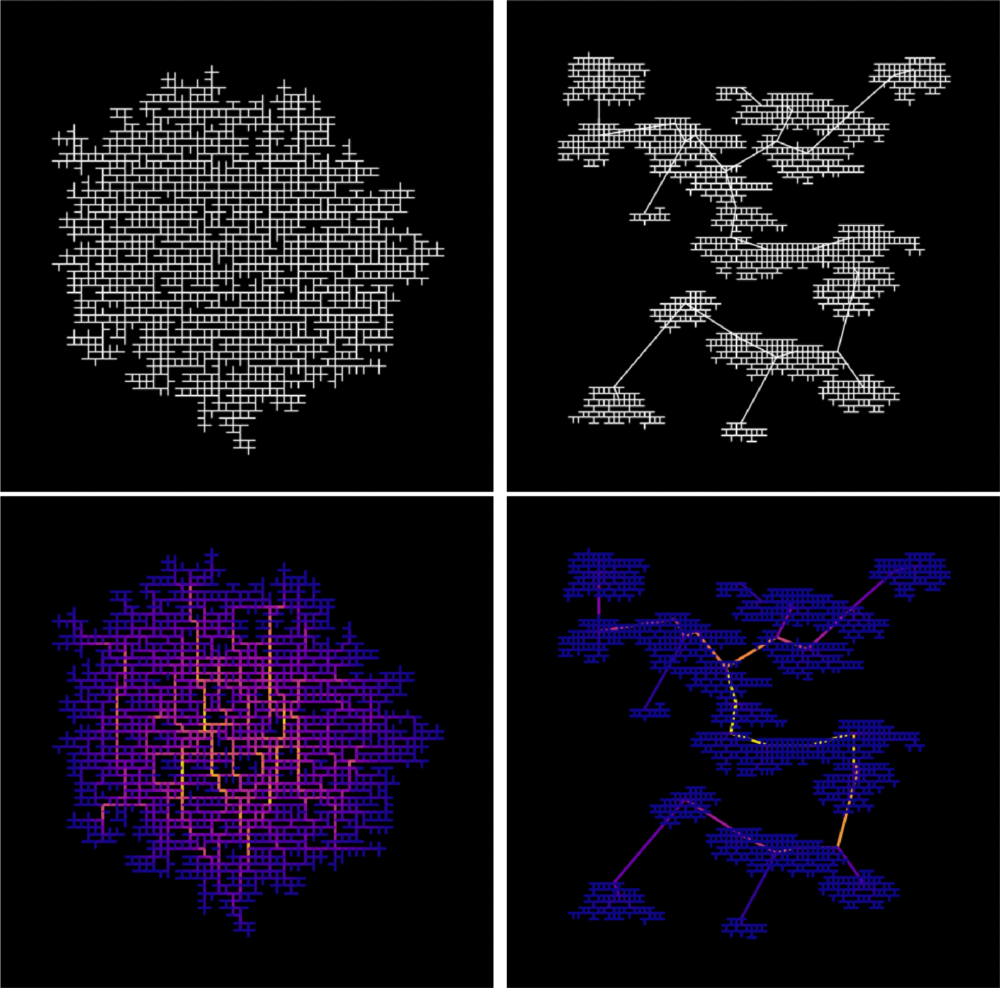
We argue that a distinguishing feature of urban street networks, which makes them unique compared to other spatial networks, is their extreme betweenness centrality heterogeneity. In plain English that means that street networks are particularly prone to chokepoints: network nodes on which a disproportionately high number of shortest paths depend. Theoretically, we can explain this as a street network that started as a backbone road, then grew and filled in as the area around it urbanized.
Building on this idea, we propose a generative model of urban street networks - that is, a model that generates street networks that reproduce this distinguishing feature. It turns out that most models don’t! Our proposed model starts with a minimum spanning tree (the initial backbone) then adds edges iteratively (the subsequent urbanization) to match empirical degree distributions. Our model, implemented in Python, reproduces key empirical characteristics well.
From the abstract:
Analyzing 9000 urban areas’ street networks, we identify properties, including extreme betweenness centrality heterogeneity, that typical spatial network models fail to explain. Accordingly we propose a universal, parsimonious, generative model based on a two-step mechanism that begins with a spanning tree as a backbone then iteratively adds edges to match empirical degree distributions. Controlled by a single parameter representing lattice-equivalent node density, it accurately reproduces key universal properties to bridge the gap between empirical observations and generative models.
For more, check out the article at PRL or the open-access arXiv pre-print.